


You're Asking the Wrong Question
"Which AI is best?" — that's the question most people ask. But it assumes there's a single winner. The right question is: "Which AI is the best fit for this specific task?"
Imagine opening four browser tabs at once: ChatGPT, Claude, Gemini, NotebookLM. Same prompt, four different answers. One brimming with confidence. One cautious, analyzing from multiple angles. One pulling data from across your Google ecosystem. One refusing to answer unless you provide your own documents.
So which one is right? None of them — because you're asking a single tool to solve multiple different problems.
A Real-World Lesson
Last week, I asked ChatGPT: "Should I pivot my content strategy toward video?" It delivered a detailed, confident plan.
Sounded logical, so I went for it.
Two months later: the video content flopped. ChatGPT never asked about my strengths, target audience, or resources. It optimized for response completeness, not decision quality.
The Four AI Archetypes: Oracle, Diplomat, Integrator, and Mirror
Each AI has its own "personality," shaped by its technical architecture. Understanding this helps you know when to use which tool.
Role | Tool | Strength | Best For |
|---|---|---|---|
Oracle | ChatGPT | Fast, confident answers | Brainstorming, exploring ideas |
Diplomat | Claude | Deep, multi-perspective analysis | Careful reasoning, nuanced decisions |
Integrator | Gemini | Cross-platform data connectivity | Google Workspace tasks, real-time info |
Mirror | NotebookLM | Reflects your own documents back | Validating decisions with your personal data |
ChatGPT — The Oracle: Best for Idea Exploration
Architecture: Open context, optimized for rapid engagement.
Use it when:
Entering unfamiliar territory: "Explain blockchain to a non-technical founder"
Rapid brainstorming: "10 angles for writing about remote work"
Speed over precision: "Draft a quick reply email"
Real-world example: I asked ChatGPT for 5 frameworks to organize content. Got results in 30 seconds. Great for exploring — not enough for picking the best option.
Blind spot: ChatGPT doesn't know what it doesn't know about you. When information is missing, it fills the gaps with generic assumptions.
Claude — The Diplomat: Best for Deep Analysis
Architecture: Open context, optimized for safety and careful reasoning.
Use it when:
Careful reasoning is needed: "What are the ethical implications of this AI use case?"
Multiple perspectives required: "Analyze this from three different philosophical frameworks"
Morally ambiguous situations with no clear right-or-wrong answer: "Should I use AI-generated images?"
Real-world example: I asked Claude about using AI images. No simple yes/no answer. Instead, Claude laid out: copyright concerns, reader perception risks, alternative options, and questions I should ask myself first.
Blind spot: Claude is so careful that you might mistake its thorough analysis for indecisiveness.
Gemini — The Integrator: Best for Cross-Platform Work
Architecture: Open context + Google ecosystem integration + multimodal processing.
Use it when:
Working with Google tools: "Analyze data from this Google Sheet, find relevant images, draft a Google Doc"
Handling multiple data types: "What's in this image and how does it relate to that document?"
Real-time information needed: "What's the latest trend on topic X right now?"
Processing long content: Reading and analyzing entire codebases or lengthy documents
Real-world example: I used Gemini to analyze my article statistics, identify top-performing topics, and connect them to current search trends.
Blind spot: "Jack of all trades, master of none" — its integration power is impressive, but individual capabilities are often outperformed by specialized tools.
NotebookLM — The Mirror: Best for Decision Validation
Architecture: Closed context (RAG). Works only with documents you upload.
Use it when:
Checking your own thinking: "Are there contradictions in these strategy documents?"
High-stakes decisions: "Based on THIS data, should I pivot?"
You want honesty: "What am I avoiding?"
Real-world example: I uploaded 5 articles about NotebookLM and asked: "What perspective am I missing?" The answer: "You haven't addressed when NotebookLM fails." That gap became the topic for my next article.
What makes NotebookLM fundamentally different: It doesn't give you answers — it removes the excuses you use to avoid the truth.
Blind spot: If the answer isn't in the documents you provide, it can't help. Garbage in, garbage out.
What Happens When You Choose Wrong? Common Failure Modes
Each AI tool doesn't just have different strengths — they also fail in their own systematic way.
ChatGPT → Action Bias
Makes fast decisions without personal context. You feel productive, but you're actually chasing generic solutions that don't fit your specific situation.
Claude → Analysis Paralysis
Too many perspectives, too much nuance — you end up never making a decision. The result is constant delays and stalled progress.
Gemini → Tool-Driven Thinking
Solutions get constrained by what the tool can do, rather than starting from the actual problem. You might build elaborate automated workflows that don't address your core needs.
NotebookLM → False Confidence from Bad Sources
If the documents you upload contain errors, NotebookLM will return those errors with complete certainty.
The problem isn't AI. The problem is a mismatch between each tool's cognitive architecture and the problem you're trying to solve.
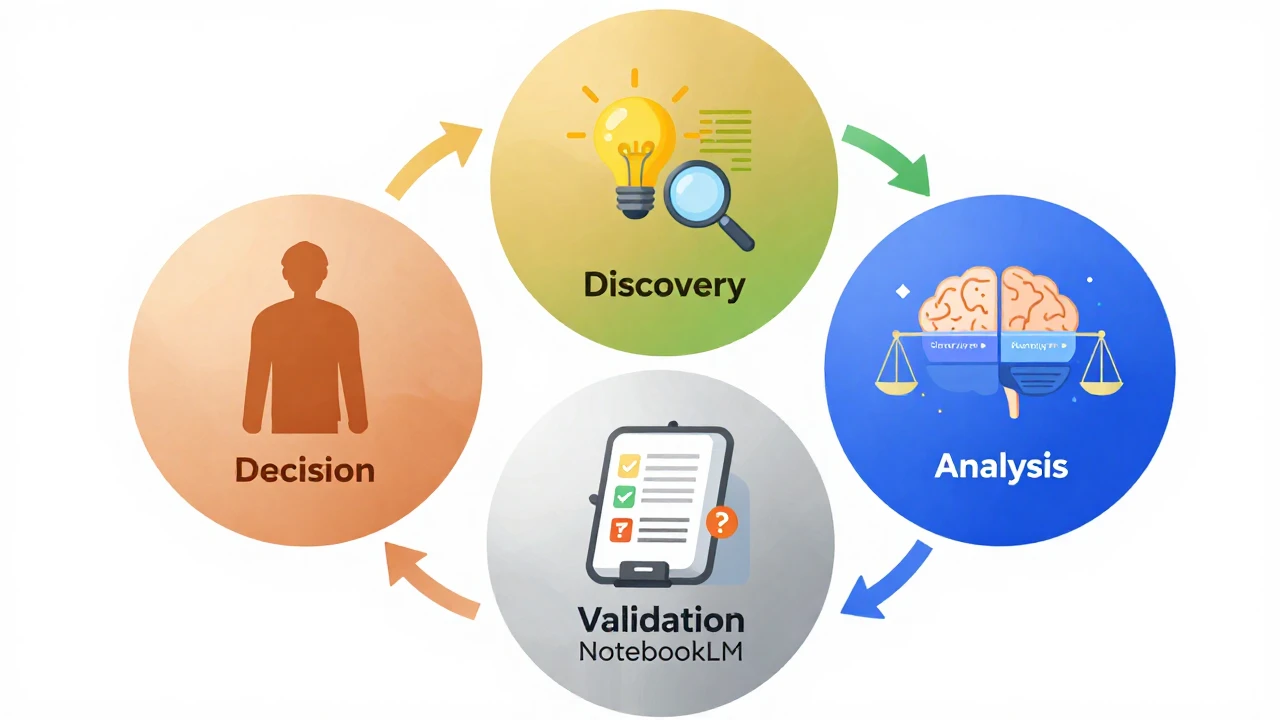
The Morpheus Workflow: Combining All Four
The real power isn't in choosing a single model — it's in knowing which sequence to use them in.
Phase 1: Discovery (Oracle + Integrator)
ChatGPT maps out all possible approaches. Gemini provides current trends and connects data from your ecosystem.
Phase 2: Analysis (Diplomat)
Claude reveals the trade-offs and weighs the pros and cons of each approach.
Phase 3: Validation (Mirror)
NotebookLM grounds everything in your specific context.
Phase 4: Decision (You)
Ultimately, you are the one who decides.
Real-world example: I needed to decide whether to offer consulting services or packaged content products.
ChatGPT mapped out viable business models
Gemini checked statistics and market trends
Claude analyzed the pros and cons of each option
NotebookLM summarized: "Your writing suggests you're better suited for packaged content products."
Result: Launched a Gumroad subscription — 28 sales, 11.2% conversion rate.
The Oracle gave options. The Diplomat gave perspective. The Integrator gave data. The Mirror gave direction. You made the call.
30-Second Checklist: Which AI Should You Open?
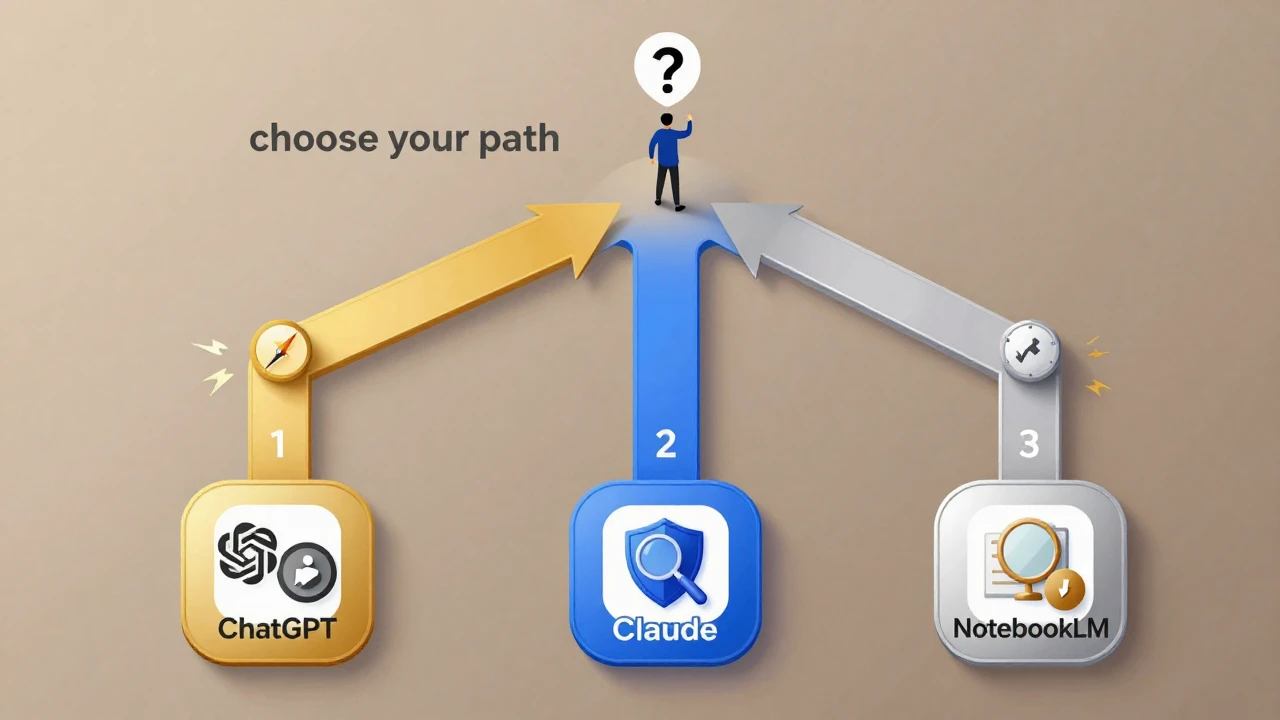
Before opening any AI tool, answer these 3 questions:
1. Are you making a decision or exploring options?
Exploring → ChatGPT or Gemini
Deciding → NotebookLM first
2. Where does your personal context live?
In documents → NotebookLM
In your head → ChatGPT or Claude to externalize your thinking first
3. What do you need most right now?
Speed → ChatGPT
Caution → Claude
Data connectivity → Gemini
Honesty → NotebookLM
Important warnings:
If you don't know whether you're exploring or deciding → don't open ChatGPT.
If you like the answer you got before checking your personal context → you're already in the danger zone.
The biggest trap is asking ChatGPT to validate a decision. It will — but it's validating a decision, not your decision.
Conclusion: AI Doesn't Make You Smarter
We're the first generation that can outsource thinking at scale. That's either liberation — or abdication of responsibility.
Most AI tools optimize for execution. Very few help you decide what's worth executing.
ChatGPT makes you faster
Claude makes you more careful
Gemini makes you more connected
NotebookLM makes you more honest
But none of them make you smarter. That's still your job.
Choose based on what you need, not what feels productive. Confidence without context always comes at a price.